
Last updated: September 2026. This guide draws on current UK hospitality cleaning standards, published 2026 market data on Liverpool’s hotel and visitor economy, and information gathered directly from Liverpool-based commercial cleaning providers, including Maid Right Cleaning Ltd.
A hotel is not an office with beds in it. A commercial office gets cleaned once the last person leaves for the day; a hotel needs housekeeping, public areas, a restaurant, a kitchen, and sometimes a spa all cleaned to a guest-facing standard while other guests are still walking through the lobby. If you manage or own a hotel in Liverpool and you’re looking at bringing in a professional cleaning contractor — or reviewing the one you’ve already got — it helps to know exactly what a proper contract should cover, how it’s priced, and what tends to drive the commercial cleaning cost up or down.
That’s what this guide sets out to do. We’ll walk through what a hotel cleaning contract should realistically include, how providers price the work (hourly, per room, or on a fixed monthly basis), the factors that most affect commercial cleaning cost for a hospitality property, and the standards and accreditations worth checking before you sign anything. We’ll also look at why Liverpool’s hotel sector specifically is worth paying attention to right now, and how local firms offering commercial cleaning in Liverpool — including Maid Right Cleaning Ltd — fit into that picture.
By the end, you’ll know enough to read a proposal from a cleaning contractor and tell whether it actually covers what your hotel needs — or whether it’s a generic commercial cleaning quote with “hotel” added to the top.
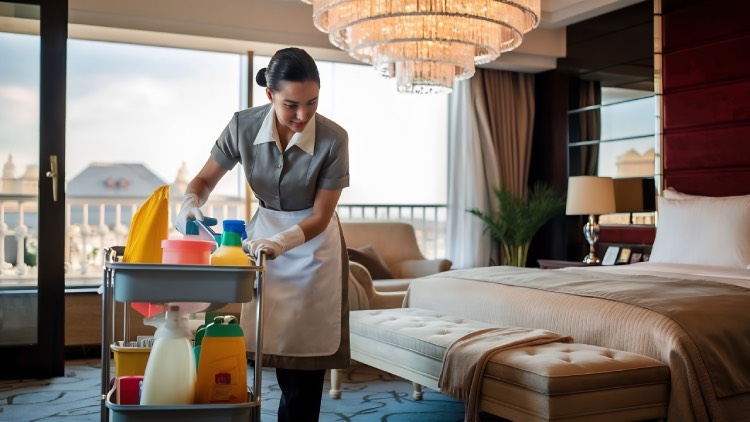
Why Hotel Cleaning Is Different From Standard Commercial Cleaning
Most commercial cleaning contracts are built around a simple pattern: clean an empty building outside of business hours. Hotels don’t work that way. Guests are checking in and out throughout the day, housekeeping needs to turn rooms around in a tight window between checkout and check-in, and public areas need to look presentable at 7am and at 11pm, not just once a day.
There’s also the range of spaces involved. A single hotel contract might cover guest bedrooms, corridors and lifts, reception and lobby, a restaurant and bar, a commercial kitchen, meeting rooms, washrooms used by hundreds of people a day, and sometimes a gym, pool, or spa. Each of those needs a different cleaning specification, different products, and in some cases different qualifications — food hygiene knowledge for the kitchen, pool chemical safety for the leisure suite.
Then there’s the guest experience factor. A dusty windowsill in an office might go unnoticed for weeks. The same thing in a hotel room shows up in a one-star review within hours, and hotel reputation is disproportionately built on cleanliness — it’s consistently one of the top two or three factors guests mention in reviews, positive or negative. That’s why hotel cleaning contracts tend to be more detailed, more frequently inspected, and priced differently to a standard office clean.
All of this means commercial cleaning cost for a hotel isn’t directly comparable to commercial cleaning cost for an office of the same square footage. A hotel contract is really pricing in labour intensity, specialist compliance, and round-the-clock presentability, not just floor area — which is worth keeping in mind when a quote looks higher than you expected from a general commercial cleaning cost guide.
What a Professional Hotel Cleaning Contract in Liverpool Should Include
A proper hotel cleaning contract is really several contracts bundled into one, because each area of the building has its own requirements. Here’s what a comprehensive proposal should cover.
Guest Room Housekeeping and Turnover Cleaning
This is the core of the job: daily servicing of occupied rooms (bed making, bathroom cleaning, restocking amenities, hoovering and dusting) plus full turnover cleans between guests, which go deeper — stripping and remaking beds, sanitising all surfaces, checking for damage, and resetting the room to standard. A good contract specifies turnaround time (how quickly a room can be ready after checkout) and what happens on high-occupancy days when dozens of rooms need turning around at once.
Public Areas and Reception
Lobbies, corridors, lifts, stairwells, and reception desks need cleaning multiple times a day, not once. Glass and high-touch surfaces (door handles, lift buttons, reception counters) should be on a frequent-touch schedule given how many people pass through them daily.
Restaurant, Bar and Breakfast Areas
Front-of-house dining spaces typically need cleaning before service, between sittings, and after close, with particular attention to tables, floors, and any self-service or buffet areas — the last of these carries food hygiene implications that a generic commercial cleaner may not be equipped to handle correctly.
Back-of-House Kitchen Deep Cleans
Commercial kitchens need periodic deep cleans covering extraction canopies, grease traps, and equipment, on top of daily front-line cleaning by kitchen staff. This is specialist, compliance-heavy work — get it wrong and you’re looking at a food hygiene rating problem, not just a cosmetic one.
Washrooms and Guest Hygiene Facilities
Public washrooms in a busy hotel see far more use than a typical office toilet and need checking and restocking multiple times daily, not on a single morning visit.
Leisure, Spa and Gym Facilities
If your hotel has a pool, spa, or gym, these carry their own hygiene requirements — pool surrounds, changing rooms, and gym equipment all need specific cleaning protocols, and pool areas in particular need staff who understand chemical safety.
Carpets, Upholstery and Hard Floors
Hotels see far heavier foot traffic than most commercial premises, so carpet and floor care — including periodic deep extraction cleaning, not just daily vacuuming — should be built into the contract on a set schedule rather than left as an afterthought.
Meeting Rooms and Event Spaces
Many Liverpool hotels now do significant business hosting conferences, weddings, and corporate events alongside overnight stays, particularly with the city’s events and visitor economy growing. Meeting rooms and function spaces need turnaround cleaning between bookings, not just an end-of-day tidy, and this is worth specifying separately if your property does regular event trade.
Linen and Laundry Coordination
Some contracts include coordination with, or provision of, linen and towel laundering; others leave this to an in-house team or separate laundry contractor. Either way, it’s worth clarifying up front whose responsibility it is, since it affects both cost and accountability if something goes wrong.
Cost Breakdown by Pricing Model
Hotel cleaning cost is structured differently from a standard commercial cleaning cost model, mostly because the workload swings so much with occupancy. A hotel can’t be priced the same way as an office that’s either occupied or empty — it needs a model that flexes with how many rooms are actually in use on a given night. Here’s how providers typically price it.
Per-Room Pricing
The most common model for guest room cleaning. Providers quote a flat rate per room cleaned, which might be £8–£16 for a daily service clean and £15–£30 for a full turnover clean between guests, depending on room size and the standard required. This model scales naturally with occupancy — you pay for rooms actually cleaned, not a fixed daily rate regardless of how full the hotel is.
Hourly Rate Pricing
Public areas, back-of-house, and specialist cleaning (kitchens, leisure facilities) are more often priced by the hour, since the workload doesn’t vary with room count in the same way. Expect £13–£22 per hour for general public-area cleaning in Liverpool, rising to £20–£35 per hour for kitchen deep cleans or specialist hygiene work, broadly in line with regional commercial cleaning rates rather than London’s premium.
Monthly or Annual Contract Pricing
Most hotels combine housekeeping and general cleaning into a single ongoing contract rather than paying per task. For a small-to-mid-sized Liverpool hotel, this typically lands somewhere between £2,500 and £15,000+ a month, depending on room count, occupancy levels, and how many public and back-of-house areas are included. Larger hotels with extensive leisure facilities and F&B operations sit well above this range. Annual contracts usually bring the effective rate down compared to rolling monthly agreements, since the provider can commit permanent staff to the site.
Per-Turn or Ad Hoc Pricing
For hotels that want to outsource only peak-occupancy support — weekends, events, or seasonal surges — rather than a full ongoing contract, providers can quote per shift or per turnover batch. This costs more per room than a full contract but avoids paying for capacity you don’t need the rest of the year.
<!– Internal linking opportunity: link “contract cleaning” to https://maidright.co.uk/contract-cleaning/ –>
Key Cost Factors That Influence Hotel Cleaning Cost
Two hotels with a similar room count in Liverpool can end up with very different quotes, and it’s rarely arbitrary. Understanding what actually moves commercial cleaning cost for a hospitality property helps you judge whether a proposal is fair before you compare it against anyone else’s.
Hotel Size and Occupancy Rate
More rooms means more cleaning hours, obviously, but occupancy rate matters just as much as room count — a 100-room hotel running at 90% occupancy needs significantly more turnover cleaning than the same hotel at 50%. Providers often build seasonal flexibility into pricing to reflect this.
Star Rating and Guest Expectations
A budget hotel and a four-star city-centre property are not the same brief. Higher-star properties typically expect more frequent public area checks, higher-spec products, and tighter turnaround standards, all of which push the commercial cleaning cost upward relative to a budget or economy property of the same size.
Turnover Frequency and Same-Day Changeovers
Same-day changeovers — where a room needs to be fully turned around within a couple of hours of checkout — cost more per room than servicing an occupied room, since the work is more intensive and often time-pressured, particularly on high-turnover weekend days.
Public Area and F&B Space
A hotel with a large lobby, multiple function rooms, a restaurant, and a bar has considerably more square footage to maintain than one with just guest rooms and a small reception, and this space typically needs cleaning several times a day rather than once.
Staffing, Wages and Compliance
Hospitality cleaning is labour-intensive, so staffing costs dominate the price. The National Living Wage rose to £12.71 an hour in April 2026, a 4.1% increase, and this feeds directly into hotel cleaning contracts given how much of the cost is wages. Add employer National Insurance, holiday pay, and the cost of DBS-checked, trained staff, and it’s clear why a contract priced well below market rate is usually cutting into staffing rather than offering genuine value.
Specialist Cleaning Requirements
Kitchen extraction cleans, pool and spa hygiene, and high-level or exterior window cleaning are typically quoted separately from routine housekeeping, since they require different equipment, training, and sometimes certification. Building these into a single contract is usually cheaper than sourcing them from separate specialists.
Access and Scheduling Around Guests
Cleaning a live hotel means working around guests rather than an empty building overnight. Providers need to schedule housekeeping within checkout-to-check-in windows, and public area cleaning often has to happen discreetly during operating hours — this operational complexity is reflected in the rate, particularly for hotels with tight turnaround requirements.
Standards, Compliance and What to Check Before You Sign
Before signing a hotel cleaning contract, a handful of checks will tell you whether a provider can actually deliver at the standard your hotel needs.
Accreditations. Look for membership of BICSc (British Institute of Cleaning Science), SSIP or SMAS Worksafe certification, and ISO 9001 quality management standards. These indicate a provider trains staff properly and follows recognised procedures, rather than sending whoever’s available that day.
Insurance and vetting. Confirm public liability insurance levels are adequate for a guest-facing environment, and that staff are DBS-checked where appropriate — housekeeping staff have access to guest rooms and belongings, so this matters more here than in a typical office contract.
Quality control and inspections. Ask how the provider audits its own work — regular inspections, guest feedback loops, or mystery-shop style checks are all good signs. A contract with no quality assurance process is a contract you’ll be personally checking every day.
Health and safety, including COSHH. Hotel cleaning involves a wide range of chemicals across different areas (kitchen, pool, guest rooms), and COSHH (Control of Substances Hazardous to Health) compliance should be a given, not an afterthought.
Incident response. Ask what happens if something goes wrong — a damaged item in a guest room, a missed deep clean before a big check-in day, a complaint from a guest. A provider with a clear escalation process is easier to work with than one that only responds when you chase them.
Sustainability. Increasingly relevant given hotel guests and corporate booking platforms both ask about environmental credentials — eco-friendly, non-toxic products and reduced water/chemical use are worth asking about if this matters to your hotel’s positioning.
Commercial Services in Liverpool’s Growing Hotel Market
Liverpool’s hospitality sector has genuine momentum behind it right now. The Liverpool City Region’s visitor economy reached a record £6.8 billion in 2025, with visitor spending up 9.3% and visitor numbers rising nearly 8% to over 61.5 million — the strongest growth the region has seen in years. That kind of demand supports a growing hotel pipeline across the city centre and waterfront, from major international brands to independent boutique properties, and major events on the wider calendar (including The Open returning to nearby Royal Birkdale) continue to draw visitors who need somewhere to stay.
More hotel rooms and higher occupancy means more competition for guest satisfaction — and cleanliness sits right at the centre of that. For hotel operators, this makes commercial services in Liverpool worth getting right rather than treating as a fixed cost to minimise. A contractor who understands hospitality specifically, rather than one applying an office-cleaning template to a 24-hour guest-facing operation, tends to be worth the difference in price.
Maid Right Cleaning Ltd is a Liverpool-based commercial cleaning provider operating across the city and into Wirral, Birkenhead, Ormskirk, Chester, and Southport, and it explicitly lists leisure and hospitality among its contract cleaning sectors, covering hotels, restaurants, and leisure centres. It’s SSIP certified, a member of BICSc, and works to ISO 9001 standards, with dedicated staff assigned to each contract so hotels get a consistent team rather than a rotating cast of unfamiliar cleaners. It currently carries a 4.9-star rating locally, which is worth checking directly if reputation and consistency matter to your decision — as they should for any business where a guest’s first and last impression is often the room they’re standing in.
If you’re comparing hotel cleaning contracts in Liverpool, it’s worth requesting a site visit and a specific quote rather than relying on a generic commercial cleaning rate card, since hospitality pricing depends so heavily on your particular mix of rooms, public areas, and specialist facilities. Providers offering broader commercial cleaning in Liverpool across offices, retail, and healthcare alongside hospitality can sometimes bundle services more cost-effectively if your business has premises beyond the hotel itself.
Liverpool-Specific Considerations for Hotel Cleaning Contracts
A few things about Liverpool’s hotel market specifically are worth factoring into any cleaning contract.
A mix of building stock. Liverpool’s hotel sector spans everything from converted Georgian and Victorian buildings in the city centre and around the Georgian Quarter to modern purpose-built towers near the waterfront and Baltic Triangle. Older buildings often need gentler products on period features and flooring, while newer builds bring their own challenges around large glazed public areas and higher guest-room density per floor. A contractor quoting the same approach for both probably hasn’t looked closely at either.
Event-driven demand spikes. Liverpool’s calendar includes major sporting fixtures, concerts at venues like the M&S Bank Arena, and a growing conference and events trade, on top of steady leisure tourism. A cleaning contract that can’t flex around a sold-out weekend — when every room turns over within hours of each other — will struggle exactly when it matters most.
City-centre access constraints. Restricted parking and loading access in the commercial district can affect how quickly cleaning teams and supply deliveries reach a property, particularly for hotels without dedicated service entrances. It’s worth asking a prospective provider how they plan around this before committing.
A competitive, growing market. With Liverpool’s visitor economy still expanding and new hotel openings adding to the room count, guests increasingly have a choice of where to stay — which puts more weight on cleanliness and presentation as a genuine competitive factor, not just a compliance box to tick.
Common Mistakes Hotels Make When Outsourcing Cleaning
A handful of avoidable mistakes come up repeatedly when hotels bring in an outside cleaning contractor.
Hiring a generalist commercial cleaner for a hospitality job. A provider that’s excellent at office cleaning isn’t automatically equipped for a 24-hour, guest-facing operation with turnover deadlines and specialist areas. Always check for hospitality-specific experience, not just general commercial credentials.
Leaving turnaround times vague. “Rooms cleaned promptly” means nothing in a dispute. Specify actual turnaround windows in the contract, especially for same-day changeovers.
No plan for occupancy surges. A contract priced and staffed for average occupancy will struggle on a sold-out weekend unless surge capacity is built in from the start.
Assuming specialist cleaning is included. Kitchen extraction cleans, pool hygiene, and high-level window cleaning are frequently excluded from a standard quote. Confirm inclusions and exclusions line by line rather than assuming a broad “hotel cleaning” quote covers everything.
Skipping the trial period. Committing to a 12-month contract without testing a provider through at least one busy period first is a common and avoidable risk — most reputable providers will accommodate a shorter initial trial.
How to Choose the Right Hotel Cleaning Partner
A few practical steps make the difference between a contract that works and one you’re renegotiating within six months.
Ask for hospitality-specific references. A provider with strong office cleaning credentials isn’t automatically equipped for hotel work — ask specifically about hotel or hospitality clients they’ve serviced, and ideally speak to one.
Get a detailed, itemised proposal. A one-line “hotel cleaning” quote tells you nothing. You want room rates, public area frequency, specialist service inclusions, and staffing levels spelled out separately.
Clarify surge capacity. Ask how the provider handles high-occupancy weekends, event bookings, or last-minute group check-ins — this is where generic contractors tend to fall short.
Check staff consistency. Hotels benefit enormously from familiar staff who know the property, rather than a different team every visit. Ask directly whether staff are dedicated to your site.
Confirm what’s excluded. Linen laundering, high-level exterior cleaning, and pest control are common grey areas — get explicit confirmation of what’s in scope and what isn’t before you sign.
Start with a trial period where possible. A four-to-eight week trial lets you assess reliability during real operating conditions before committing to a longer contract.
Frequently Asked Questions
What’s included in a typical hotel cleaning contract? A comprehensive contract usually covers guest room housekeeping and turnover cleaning, public areas and reception, restaurant and bar spaces, kitchen deep cleans, washrooms, and often leisure facilities such as a gym, pool, or spa. Carpet and floor care is typically scheduled separately from daily cleaning.
How much does hotel cleaning cost in Liverpool? Per-room rates typically range from £8–£16 for a daily service clean up to £15–£30 for a full turnover clean, while public-area and specialist cleaning is usually priced hourly at £13–£35 depending on the work involved. A full monthly contract for a small-to-mid-sized hotel commonly falls between £2,500 and £15,000 or more, depending on size and scope — commercial cleaning cost for a hotel is almost always quoted per property rather than as a flat rate, so treat these as guide figures.
Is it cheaper to outsource hotel cleaning or keep an in-house team? It depends on scale and occupancy volatility. Outsourcing avoids the fixed cost of employing and managing a housekeeping team directly, and lets you scale cleaning capacity with occupancy, which tends to suit hotels with seasonal or variable demand better than a fixed in-house headcount.
How often should public areas in a hotel be cleaned? Lobbies, corridors, and washrooms typically need cleaning multiple times a day rather than once, particularly high-touch surfaces like door handles and lift buttons. The exact frequency should be specified in the contract rather than left as “regular” cleaning.
Do hotel cleaning contracts include kitchen deep cleans? Not always as standard — kitchen deep cleans (extraction, grease traps, equipment) are often quoted separately from front-of-house cleaning because of the specialist compliance requirements involved. Confirm this explicitly before assuming it’s covered.
What accreditations should a hotel cleaning provider have? Look for BICSc membership, SSIP or SMAS Worksafe certification, and ISO 9001 quality standards, alongside adequate public liability insurance and DBS-checked staff. These indicate a provider that trains staff properly and follows recognised procedures.
How quickly can a hotel room be turned around between guests? This varies by provider and room type, but a well-staffed contract should be able to fully turn a standard room around within 30–45 minutes on a normal day, with clear surge planning for high-occupancy changeover days.
Can hotel cleaning contracts flex with seasonal occupancy? Yes, and they should. A good contract builds in flexibility for occupancy swings, event weekends, and seasonal peaks rather than charging a flat rate regardless of how full the hotel is — this is usually structured through per-room or per-shift pricing rather than a fixed monthly fee.
Why does cleanliness matter so much for hotel reviews? Cleanliness is consistently one of the most-cited factors in hotel guest reviews, positive and negative, because it’s one of the most visible signals of overall quality guests can assess for themselves. A single overlooked detail in a guest room can disproportionately affect a review compared with the same lapse in a non-guest-facing environment.
Final Thoughts
Hotel cleaning is a genuinely different job from standard commercial cleaning, and a contract that doesn’t reflect that — one built for an empty office rather than a live, guest-facing building — tends to show up as complaints, inconsistent standards, or surprise costs down the line. Knowing what a proper contract should cover, how commercial cleaning cost is actually structured for a hospitality property, and what to check before signing puts you in a much stronger position, whether you’re setting up cleaning for a new property or reviewing an existing arrangement.
If you’re weighing up options for hotel cleaning in Liverpool, Maid Right Cleaning Ltd offers free, no-obligation quotes for hospitality and leisure properties across Liverpool, Wirral, Birkenhead, Ormskirk, Chester, and Southport. Get in touch at 0151 440 2650 or [email protected] to talk through what a tailored contract would look like for your hotel.


Leave a Reply